What is Ability to Benefit?
The Ability to Benefit (ATB) provision in the Higher Education Act gives eligible adults without a high school diploma or equivalent access to federal student aid. A critical dual enrollment strategy, ATB ensures access to postsecondary education for adults working to complete their high school credential. Unfortunately, it remains poorly understood and massively underutilized, in no small part due to legislative changes.
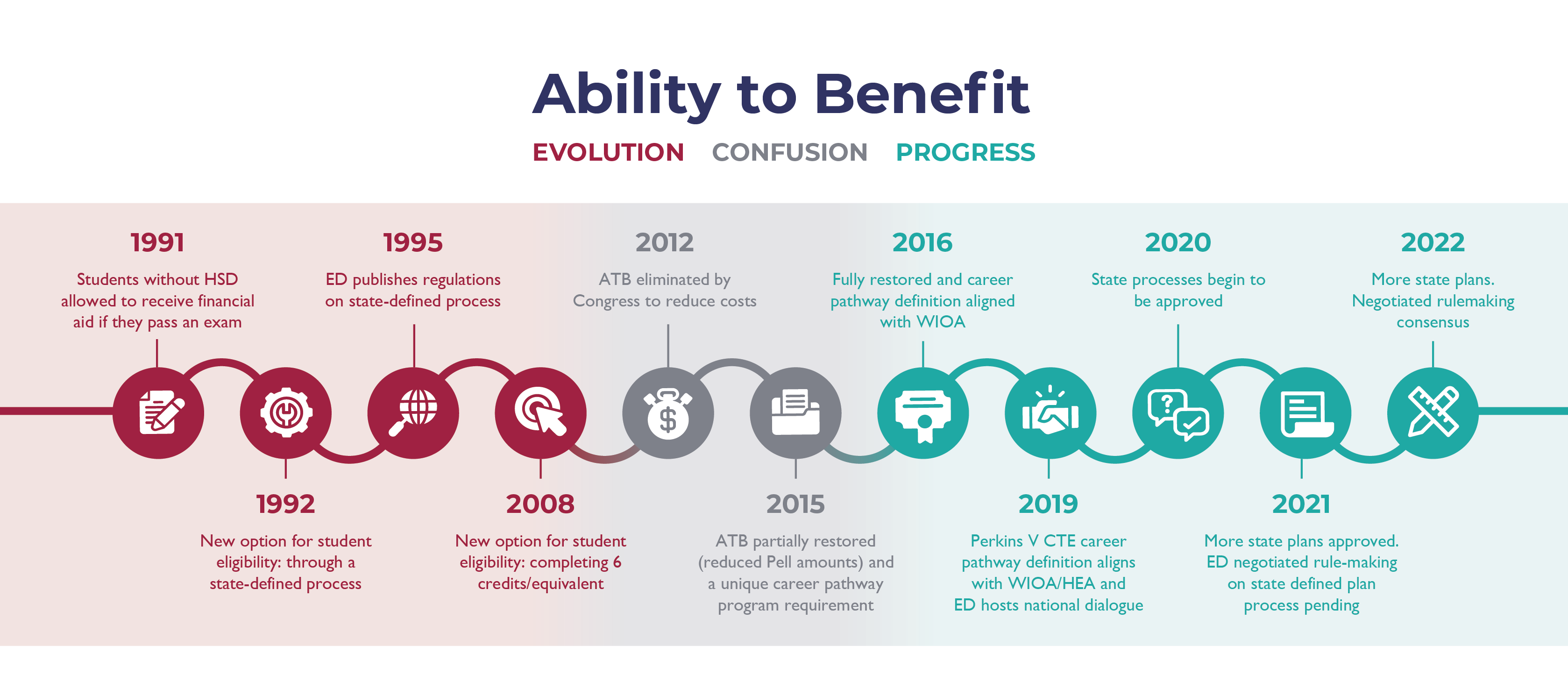
Under ATB, eligible adults can receive federal student aid (primarily Pell Grants) while earning a postsecondary credential and completing their high school diploma or equivalent at the same time. To be eligible for ATB, an adult must enroll in a specific type of program called an eligible career pathway program (ECPP) and complete one of the three ATB eligibility options to demonstrate their “ability to benefit” from postsecondary education:
- pass a U.S. Department of Education-approved test;
- complete six credit hours (or 225 clock hours) towards a postsecondary credential; or
- be admitted through an approved state process.
NCTN’s Recent ATB Projects
NCTN provides technical assistance to state systems and institutions to scale and sustain Ability to Benefit implementation. If you‘re interested in technical assistance, please email Sandy Goodman at sandy.goodman@jsi.org.
Dual Enrollment for Adult Learners (DEAL)
The Dual Enrollment for Adult Learners (DEAL) project, funded by the U.S. Department of Education’s (ED) Office of Career, Technical, and Adult Education (OCTAE), aimed to support states in the development and implementation of Ability to Benefit (ATB) state processes, expanding adult learners’ access to postsecondary education and training through the use of federal student aid. DEAL was led by the Manhattan Strategy Group LLC (MSG); World Education, an initiative of JSI; and RTI International. (2024–2026)
Resources
- Dual Enrollment for Adults: A Toolkit to Support the Use of Ability to Benefit in America's Colleges, developed by the DEAL team, serves as a resource for institutions and states interested in implementing and expanding ATB usage to support dual enrollment for adult learners.
Ability to Benefit in California
World Education collaborated with the California Community Colleges Chancellor’s Office to provide technical assistance on the implementation of California’s recently approved state process for Ability to Benefit (ATB), including facilitating a Community of Practice for a cohort of pilot colleges and providing policy and implementation recommendations to scale and sustain ATB usage in the state. (2024–2026)
Communities for Advancing ATB
Building on the momentum of the Advancing ATB for Equitable Access to Opportunity project and recent changes in ATB regulations, Communities for Advancing ATB aimed to provide a space for ATB leaders and practitioners across the country to learn from each other and leverage the power of community to advance ATB usage. In collaboration with the Minnesota State Colleges and Universities system, World Education’s National College Transition Network supported the first national ATB learning community, where state leaders could share expertise, discuss challenges, and receive ad hoc technical assistance from World Education. Based on the learning community’s needs, World Education also developed public resources and webinars to support states and institutions in the implementation of the new ATB regulations. This work was generously supported by Lumina Foundation. (2024–2025)
Resources
- The Ability to Benefit Eligible Career Pathway Program Documentation Checklist is an internal resource intended to help ATB implementation teams at institutions identify and compile the eligible career pathway program (ECPP) documentation required for federal approval. (Updated 2026)
- Webinar recording: Implementing Ability to Benefit and Career Pathways to Support Adult Learners’ Transitions to Postsecondary Education and Beyond (2025)
- Webinar recording: Boost Financial Aid Access: Harness Ability to Benefit Changes to Support Adult Learners (Passcode: LgV5V!&.) (2025)
A2B4Equity
The A2B4Equity program is focused on leveraging the Ability to Benefit (ATB) provision of the federal student aid program—specifically the credit hour option—to provide access to federal student financial aid for adult students without a high school diploma or equivalent. The pilot project hypothesis was that college promise funding could be used to fund the first six credit hours required in the credit-hour ATB option. Under the credit-hour ATB provision, if adult students without a high school diploma or equivalent successfully complete six credit hours in an eligible career pathway program (sans student financial aid), they can “prove their ability to benefit” from college and apply for federal student aid to fund the rest of their college program. Corporation for a Skilled Workforce (CSW) managed the pilot, and World Education, a division of JSI, provided technical assistance on implementing the ATB provision. This work was funded by ECMC Foundation. (2022–2024)
Resources
- The Unsung Student Aid Option: A College Leader’s Guide to Implementing the Credit-Hour Ability to Benefit Provision in the Federal Student Aid Program (2024)
- A2B4Equity Pilot Project to Leverage Proxy College Promise Funding and Ability to Benefit to Advance Adult Student College Access and Educational Equity: Final Evaluation Report (2024)
Advancing ATB for Equitable Access to Opportunity
The Ability to Benefit (ATB) provision in the Higher Education Act is a critical but underutilized strategy for ensuring equitable access to postsecondary education and—by extension—economic stability. Through Advancing ATB for Equitable Access to Opportunity, World Education advanced the racial equity work of three states participating in the Racial Equity for Adult Credentials in Higher Education (REACH) Collaborative by supporting each state in the creation and implementation of an intentional ATB strategy. The three participating states were California (through the Career Ladders Project), North Carolina (through the North Carolina Community College System), and Texas (through the Texas Success Center). This work, as well as the work of the REACH Collaborative, was generously supported by Lumina Foundation. (2022–2023)
Resources
ATB Resources
NCTN has compiled a comprehensive list of ATB resources for states and practitioners. View the ATB resources page.
Resource Spotlight
Dual Enrollment for Adults: A Toolkit to Support the Use of Ability to Benefit in America’s Colleges is a new resource that was developed by Alexis Cherewka, Shirley Doan, and Sandy Goodman from World Education, an initiative of JSI. It references research and technical assistance (TA) activities conducted by the Dual Enrollment for Adult Learners (DEAL) project, led by Manhattan Strategy Group and funded by the U.S. Department of Education. (2026)
The Ability to Benefit Eligible Career Pathway Program Documentation Checklist, developed by World Education, is an internal resource intended to help ATB implementation teams at institutions identify and compile the eligible career pathway program (ECPP) documentation required for federal approval. (2026)